Apex Forensics · Special Investigation


Today is the day, don't wait any longer

653 pages · 400 recipes · 4 modules · 4 bonuses included

Investigated cookbook · Kids 3 to 12 · 2026 edition

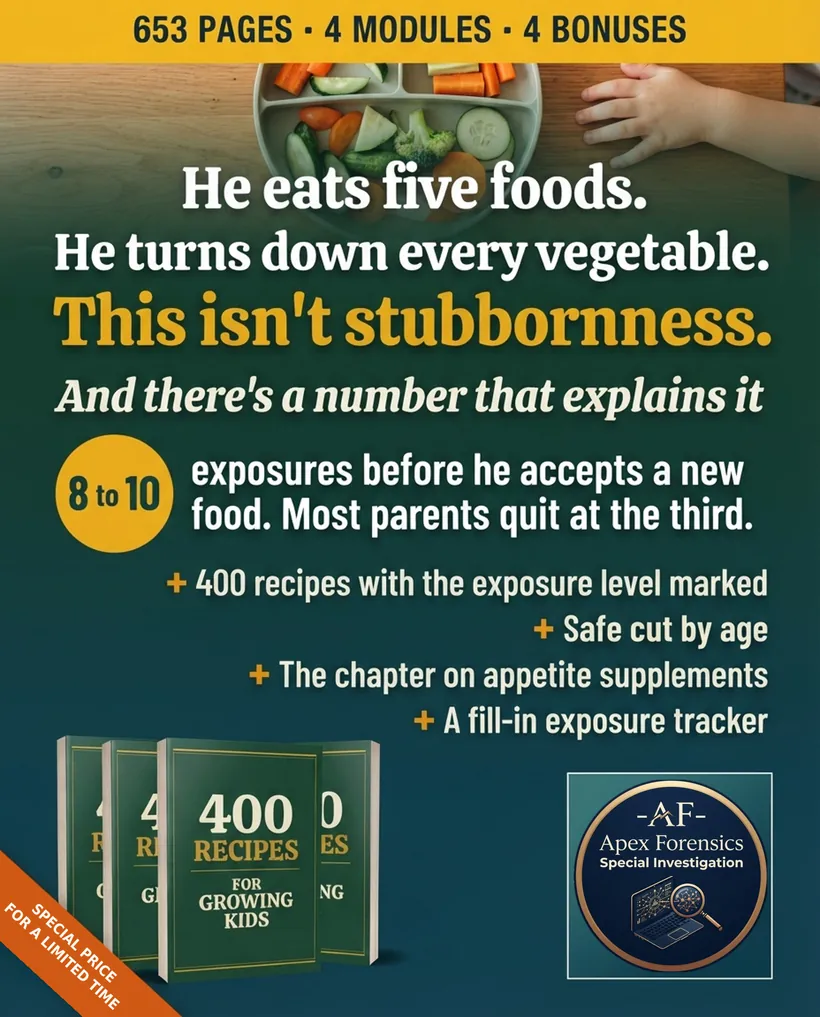
He eats five foods and turns down every vegetable It isn't stubbornness

There's a number that explains it. A child needs eight to ten encounters with a new food before accepting it. Most parents quit at the third, convinced the problem is the kid.

  • 400 recipes, each with a six-line card you can read in ten seconds
  • Safe cut by age on every recipe that carries a choking risk
  • School-safe and nut-free status flagged before you pack the lunchbox
  • 56 feeding myths put on trial, one by one, with the source shown
  • 4 complete bonuses, 46 extra pages
400 Recipes for Growing Kids, with 4 bonuses included
See the full offer653 pages · instant download

7-day guarantee · One-time payment, no subscription

If you're here, this probably sounds familiar

Dinner has turned into a negotiation

You cook, he sits down, looks at the plate and pushes it away. Then come the pleading, the threat, the "just one more bite" and dessert held hostage. And tomorrow, all over again.

Your kid isn't a strange case. Nobody gave you the number.

Eight to ten exposures before he accepts a new food; most parents quit at the third

The verdict of the investigation

You didn't quit late. You quit early.

The systematic reviews are consistent on this: offering a fruit or a vegetable once a day for eight or ten days raises acceptance. It isn't a technique or a trick, it's how a child learns to eat. And at home almost nobody gets that far, because after the third refusal the conclusion people draw is "he doesn't like it."

There's something else almost nobody knows: between two and six, the encounter that never reaches his mouth counts too. Seeing it on the table, touching it, smelling it, washing it with you. All of that goes on the tally, and it's what keeps you moving on the days he won't even taste it.

Most parents quit at the third try.

Three of the fifty-six myths that went to trial

What gets repeated and what holds up

Every myth goes through the same file: what it promises, what was actually measured, what the verdict is, and what to do instead. These three are the ones every picky-eater book sells you.

Partly true

What gets repeated

"Just hide the vegetables in the sauce"

It's the single most repeated tip in the category, and the one that buys the most peace in the short term.

The verdictIt works as a nutritional floor: in preschoolers, adding puréed vegetables to dishes they already liked nearly doubled the vegetables eaten. But the child never learns to recognize them or to like them, and if the trick is discovered you break something harder to repair. It's a safety net, not a method. The book teaches you to move up a level instead of hiding forever.
Busted

What gets repeated

"Try an appetite stimulant"

Passed along parent to parent, and easier to get than it should be.

The verdictThe drug most often used for this is an antihistamine: the appetite increase is a side effect, not what it was created for, and it causes drowsiness. Without an identified deficiency, there's no solid evidence that a gummy multivitamin, a toddler milk or a nutrition shake opens a healthy child's appetite or makes him grow. It's the chapter no cookbook writes, and here it's a whole bonus.
Busted

What gets repeated

"Two more bites and you get dessert"

It sounds like reasonable discipline and it's used at nearly every table in the country.

The verdictUsing sweets as the prize raises the preference for sweets and casts the vegetable as the punishment. Even telling him a food "is good for you" backfires: in preschoolers it reduced how much they ate. What can help with a first taste is a reward you don't eat.
Confirmed

8

Partly true

11

Needs work

6

Busted

31

Eight ideas survived out of fifty-six. All eight are free, and two of them save you money.

The solution

Four hundred recipes and a card you read in ten seconds

Because at six in the evening you're not going to read a chapter: you're going to open a page, scan six boxes and decide. The card tells you the age it works from, what the dish delivers, and which exposure level you're placing that food at.

Recipe no. 305 · Group 16

Cherry tomatoes with mozzarella and basil

Serves
4
Time
10 min
Age from
12 mo
Added sugar
None
Delivers
Calcium
Exposure
In plain sight

Exact amounts, never "to taste"

Numbered steps, with nothing hidden between them

What to use instead if you can't find an ingredient

Safe cut by age · School-safeUnder four, cherry tomatoes go quartered lengthwise. Never whole, never in rounds. Nut-free: yes — packs for a nut-free classroom.
Exposure trackerA box to check the day it appears on the table, even if he doesn't eat it. Because seeing it counts too.

This is what each of the 400 pages looks like

  • 1The ten-times ruleThe number that runs through all 400 recipes. You offer, you check the box, and you draw no conclusion until the tenth appearance. That's where half the battles end.
  • 2The division of responsibilityYou decide what, when and where. He decides how much and whether. It's the one change that stops dinner from being a negotiation, and it costs nothing.
  • 3The exposure ladderEvery recipe is marked hidden, mixed, or in plain sight. And the book teaches you how to climb, instead of puréeing vegetables into sauce for the rest of your life.
  • 4Safe cut and school-safeGrapes, cherry tomatoes, hot dogs, nuts, raw carrot: the specific cut and the age it applies from. Plus nut-free status on all 400, checked before you pack it.

Is this book for you?

We'd rather you know now than after you buy.

Yes, if this is you

  • Your child is between 3 and 12 and eats five or six foods
  • You cook two dinners every night and can't keep it up
  • You already bought an appetite supplement and want to know what the research says
  • You pack a lunchbox for a nut-free classroom and want it flagged before you cook
  • You want to know how to cut grapes, cherry tomatoes or hot dogs without looking it up every time
  • You want to know where every claim comes from before you believe it

No, if you're after this

  • Purée or baby-led weaning recipes: this book starts at 12 months and is built for ages 3 to 12
  • A plan to make your child lose weight: there is no restriction guidance here, and we explain why
  • Treatment for a diagnosed allergy, celiac disease or ARFID: that belongs with their doctor
  • Someone selling you the supplement the book recommends: we sell none
  • Beautiful photos of plates: there are none, there are charts, cards and data
  • A trick that works tonight: this mechanism is measured in weeks, not dinners

What's inside

400 recipes, four modules, twenty groups

One hundred recipes per module, twenty per themed group, one recipe per page, and not a single repeat across the 400. Every group opens with the evidence behind it, cited by name.

Module 01 · 152 pages

The Diagnosis

Why he won't eat what you cook. The module that explains what's normal at his age and what isn't.

  • The appetite drop between 2 and 5
  • The ten-times rule and Satter's division of responsibility
  • Choking: risk foods and safe cuts
  • Hide it or show it: the debate settled
  • Breakfasts, lunchboxes, 20-minute dinners and soups

Module 02 · 152 pages

Protein and Iron

Families watch the protein, which is almost always plentiful, and miss the iron, which usually isn't.

  • How much protein is actually needed, by age
  • What helps and what blocks iron absorption
  • Milk in its proper place
  • The child who won't eat meat
  • Eggs, chicken, fish, beef and beans

Module 03 · 151 pages

Sugar and the Package

Your kid's sugar isn't in the candy bowl. It's spread in small doses across his whole day.

  • Added sugars on the Nutrition Facts panel
  • The fourteen names sugar goes by
  • Why juice counts and whole fruit doesn't
  • The kids' aisle, product by product
  • Breads, desserts, drinks and spreads

Module 04 · 152 pages

Real Life

The cafeteria, the party and grandma. The territory you don't control, and which matters less than you think.

  • Reading the school lunch menu in five minutes
  • The other adult: the table of exact scripts
  • The seven techniques that actually move vegetables
  • American comfort classics, rebuilt
  • Birthdays, holidays and the two-hour Sunday

What no competing cookbook does

Every recipe is cleared for the lunchbox before you cook it

Nut-free classrooms, allergy policies taped to the fridge, a bag that has to survive four hours without a fridge. Most cookbooks leave you to work that out at six in the morning. Here all 400 recipes carry a school-safe line, so you know before you start cooking — not after you've packed it.

Flagged on all 400Nut-freeCleared for a nut-free classroom, or the swap that clears it
Flagged on all 400Travels coldWhether it holds up in a bag with an ice pack until noon
Flagged on all 400Eats coldWhether it needs reheating or works straight from the box
Flagged on all 400Hands onlyWhether it can be eaten without a fork in a cafeteria

A recipe that can't leave the house isn't a lunchbox recipe.

Why you can trust it

Pediatric bodies and federal sources, cited by name

We're Apex Forensics · Special Investigation. We don't write what sounds good: we write what holds up, and we say exactly where it comes from. Full APA bibliography with author, journal and year, so you can go check it yourself.

The framework the whole book rests on

The division of responsibility in feeding is the one approach in this field with real validation behind it, and it's disarmingly simple: the adult decides what is served, when, and where. The child decides how much, and whether. Nearly every dinner-table battle in this country comes from an adult crossing into the child's half of that line — usually with the best intentions.

Satter, E. The Satter Division of Responsibility in Feeding (sDOR). Ellyn Satter Institute.

What this book does not do

A cookbook doesn't replace your pediatrician

And there are two things we deliberately left out, even though the product would have sold better with them.

No weight targets and no restriction plans

If you're worried about your child's weight, in either direction, this book will not hand you a diet, a number or a plan. Not because we couldn't write one, but because that gets assessed in an office with the child's growth chart in front of you. What you will find is how to read that chart without panicking, why commenting on a child's body in front of them backfires, and the specific signs that mean it's time to book an appointment. The rest is your pediatrician's job.

Some situations are out of scope

Diagnosed food allergies, celiac disease, eating disorders, ARFID, prematurity, chronic illness, and children under one year. The book says so on page one and repeats it where it matters. If your child is losing weight, stalling in height, choking repeatedly or refusing food with pain, that isn't picky eating — that's an appointment.

Included with your purchase

Four complete bonuses, 46 extra pages

They aren't loose handouts. They're four short books that solve the four things that worry parents most and that no cookbook touches.

The Growth Chart10 pages

How to read the percentile without panicking. A percentile is a position, not a grade, and what matters is the channel, not the dot. With the most common measurement errors and the signs that mean it's time to call.

Reference value $9 Today: included

The Supplement Aisle12 pages

Nine products investigated one by one, with a verdict. From the prescription appetite stimulant to gummy vitamins, toddler milks and nutrition shakes. Includes the questions to ask before buying any of them.

Reference value $5 Today: included

The Table Without a War14 pages

Forty exact scripts for the moments that actually happen, in two columns: what not to say and what to say instead. Some of the correct answers are to say nothing. The last one is "you lost your temper and you feel terrible."

Reference value $5 Today: included

The Twelve Weeks12 pages

One change at a time, in three-week blocks, with the fill-in exposure tracker. You mark the appearance, not what he ate. Week eight is the boring one, which is exactly where everybody quits.

Reference value $5 Today: included

All four download alongside the cookbook, at the same moment and at no extra cost.

Rating from people who already bought it

5.0 ★★★★★
Overall rating on Hotmart

Score given by verified buyers on the product page inside Hotmart.

The offer

Everything you get today

Complete package · Instant PDF download

400 Recipes for Growing Kids
  • 400 Recipes for Growing KidsAll 4 modules, 607 pages, one recipe per page with serves, time, age from, added sugar, what it delivers, exposure level and school-safe status.$75
  • Bonus 1 · The Growth Chart10 pages. Reading the percentile without panicking.$9
  • Bonus 2 · The Supplement Aisle12 pages. 9 products investigated one by one, with a verdict.$5
  • Bonus 3 · The Table Without a War14 pages. 40 exact scripts for the moments that actually happen.$5
  • Bonus 4 · The Twelve Weeks12 pages. One change at a time, with the fill-in exposure tracker.$5
  • Total package value$99
Special price for a limited timeComplete package with all 4 bonuses

Reference value $99

US$9.90

Get my cookbook now653 pages · instant access

One-time payment · No subscription · No renewal

Secure payment by Hotmart7-day guaranteeInstant download
7day
guarantee

If it isn't what you expected, you don't pay for it

You have seven full days from purchase to go through all 653 pages at your own pace. If the book isn't what you pictured, you request the refund from Hotmart's own platform — no need to write to us, no explanation, no argument. You get the full amount back.

We say it because we're certain of one thing: the risk on this product shouldn't be yours. If in a week you can't find at least ten recipes you'd actually cook, we didn't do our job and we don't want your money.

Frequently asked questions

What ages is it for?

It's built for kids 3 to 12, which is the range the market ignores: almost everything out there is for babies and starting solids. Every recipe states the age it works from, and none goes below 12 months. For children under one, the book explicitly sends you to your pediatrician.

How and when do I get it?

As soon as the payment clears, Hotmart emails you the access. You download the PDFs and they're yours forever: read them on your phone, your computer or a tablet, and print them in US Letter. There's no subscription and no expiration.

Will my kid eat vegetables after this?

We don't know, and anyone who promises that with a date is making it up. What we do know is what the book does: it gives you the number of tries worth sustaining, four hundred different ways to put that food on the table, and a way to stop turning every dinner into a negotiation. Most families don't fail for lack of recipes — they fail by quitting at the third try.

My child is above the weight range. Does this help?

It helps as a cookbook, with one important caveat: you will not find a diet, a number or a restriction plan for a child in here. That gets assessed in an office with their growth chart in front of you. What the book does give you is how to read that chart, why commenting on their body in front of them backfires, and when to book an appointment.

What exactly is the school-safe line?

Every one of the 400 recipes tells you, before you cook, whether it's nut-free or what swap makes it nut-free, whether it survives a bag with an ice pack until lunch, whether it can be eaten cold, and whether it needs a fork. It's the piece that turns a cookbook into something you can actually pack at six in the morning.

And the safe cut?

Every recipe carrying a choking risk states how to cut the food and from what age: grapes and cherry tomatoes quartered lengthwise, nuts ground until four or five, hot dogs never in rounds. It follows pediatric guidance and no competing cookbook includes it.

What are the "56 feeding myths put on trial"?

They're the fifty-six claims that circulate most about feeding children, run through a fixed file: what each one promises, what was actually measured, what the verdict is, and what to do instead. Eight survived. And some verdicts go against what would have been convenient for the book to say — that sugar doesn't cause hyperactivity, for one, and that banning foods backfires.

What if it isn't for me?

You have a 7-day guarantee through Hotmart. You request the refund on the platform and get the full amount back, with no explanation required.