
Apex Forensics · Special Investigation


Today is the day, don't wait any longer

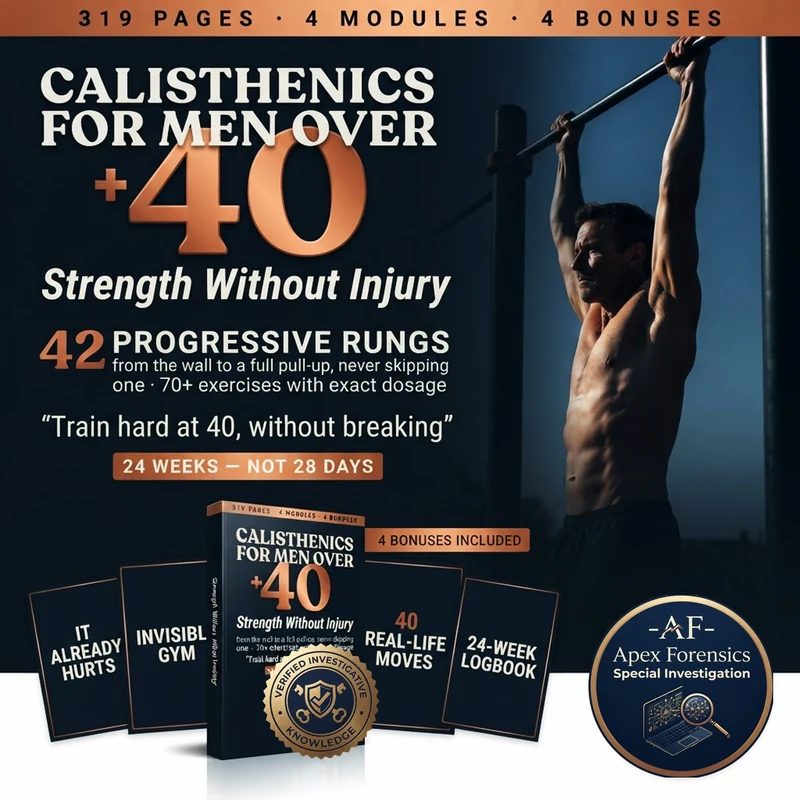
319 pages · 42 rungs · 4 modules · 4 bonuses included

Investigated course · Men 40 to 60 · 2026 edition

Train hard at forty without breaking

Muscle adapts in weeks. Tendon takes months. After forty you get hurt in exactly that gap, when your strength has run ahead of the tissue that has to hold it. The whole method is built around those two clocks.

  • 24 weeks, not 28 days — and there's a reason, explained below
  • 42 progressive rungs, from a wall push-up to a full pull-up
  • 70+ exercises with exact dosage and a numerical gate to move up
  • No gym and no weights: a wall, a floor, a chair, a doorframe and a backpack
  • 4 complete bonuses, 116 extra pages
Calisthenics for Men Over 40, Strength Without Injury, with 4 bonuses included
See the full offer319 pages · instant download

7-day guarantee · One-time payment, no subscription

If you're here, this probably sounds familiar

You want back in, but you can't afford six months out

It isn't that you don't want to. It's that you already know what an injury costs at this age, and you're not paying it again for starting wrong.

The problem isn't your age. It's starting with no idea where you stand.

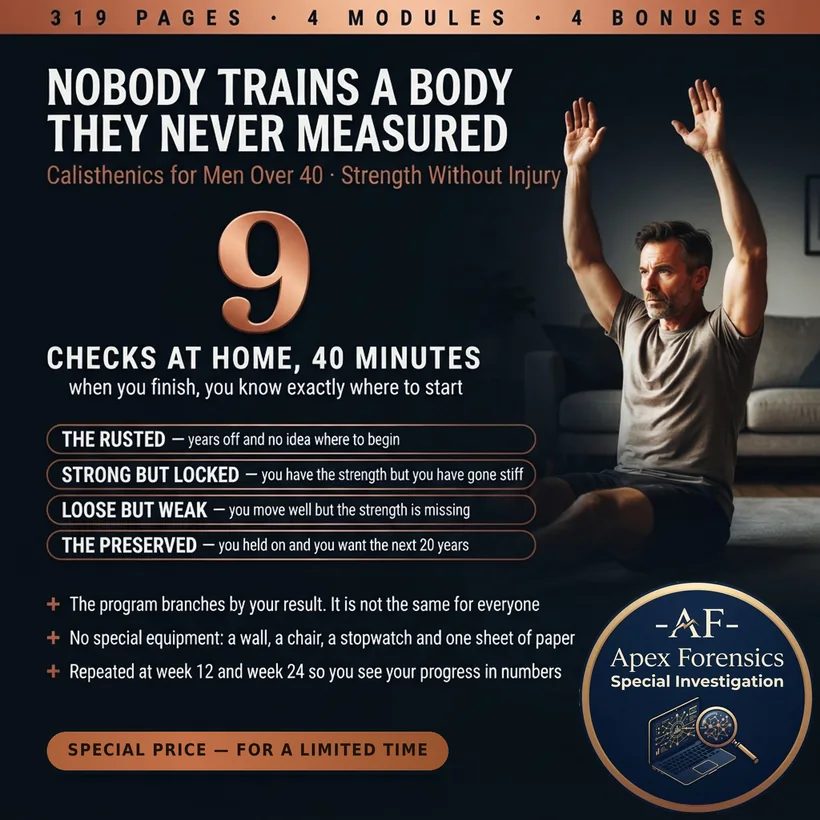
The Apex Test: nine checks at home in forty minutes and four starting profiles

The verdict of the investigation

You don't get hurt from training. You get hurt in the gap.

Strength climbs fast and tissue trails behind it. Somewhere after the first few weeks a gap opens: you can already do more than your tendon can take, and that's where most men who come back after forty get hurt. It isn't bad luck and it isn't your age. It's a specific stretch of time, and it can be managed.

That's why the course starts by measuring. Nine checks you run alone at home, with a chair and a stopwatch, in forty minutes. Out of that comes your starting profile, and the program branches on the result: the man who's been off for ten years doesn't get the same plan as the man who's strong but locked up.

Nobody trains a body they never measured.

Three things repeated in every gym in the country

What gets repeated and what holds up

Each one goes through the same question: what was promised, what was actually measured, and what to do instead.

Busted

What gets repeated

"Stretch before you train and you won't get hurt"

It's what we were taught in gym class and what almost everyone still does before starting.

The verdictStatic stretching before training doesn't reduce the overall injury rate, and past sixty seconds it costs you strength in that session. Worse: a 2023 review found that strength training improves range of motion as much as stretching does, with the biggest gains in sedentary people. Module 2 gets your mobility back without stretching once.
Busted

What gets repeated

"After forty you can only maintain"

It's said with resignation and it sounds reasonable, so almost nobody argues with it.

The verdictWhat goes first isn't mass, it's power: roughly 2 to 4 % a year, against 0.5 to 1 % of muscle mass. And power responds to training at any age. The problem is that no "for older adults" program includes speed work, which is exactly what's disappearing fastest. Here there's a small, measured dose with four prerequisites.
Partly true

What gets repeated

"If it doesn't hurt while you train, you're fine"

It sounds like common sense, and it's the reason so many men find out too late.

The verdictTrue for muscle, not for tendon. Connective tissue doesn't complain during the set: it complains the next morning. That's why the signal that decides whether you move up a rung isn't what you feel training — it's how you wake up twenty-four hours later. It's the double-gate rule, and it prevents most injuries.

The solution

Forty-two rungs, and a gate on every one

Every exercise in the course comes with the same card: what it does, which position protects you, which rung you're on, exactly what you have to hit to move up, what to swap it for if something starts aching, and where it lands in your week.

Rung 4 of 6 · Horizontal push

Push-up with hands on a bench

Sets
3
Reps
8-12
Tempo
3-0-1
Rest
90 s
Frequency
2 /wk
Equipment
Chair

The position that protects you: elbows at 45°, never flared out

The cue: your chest touches before your hips do

The usual mistake: lowering your head and calling it a rep

The gateYou move to rung 5 when you hit 3×12 at full tempo and wake up with no ache the next day. Both conditions, not one.
If it hurtsShoulder complaining: raise your hands higher and cut range, not sets. Wrist complaining: fists or parallettes. The exact substitution is on the card.

This is what each of the 42 rungs looks like

  • 1The two clocksThe principle that orders the whole course. Muscle adapts in weeks and tendon in months, so progression isn't set by how strong you feel — it's set by what the tissue can follow.
  • 2The gateEvery rung carries a numerical criterion for moving up. No "when you feel ready": you either hit the number or you stay where you are one more week.
  • 3The double-gate ruleYou only move up if you hit the strength criterion and wake up with no ache twenty-four hours later. It's what keeps strength from outrunning tissue.
  • 4Substitute, don't stopIf something aches you don't quit training: you swap that movement for one that keeps the pattern without loading the area. There's a whole bonus on this.

The one number that separates this from everything on Amazon

24 weeks. Not 28 days.

The market is flooded with 28-day and 30-day challenges. Here's the problem with all of them: four weeks is roughly where the gap between your strength and your tissue is at its widest, and it's also exactly where those programs hand you a congratulations page and disappear. You finish the challenge right in the middle of the stretch that actually needed a plan.

The gap
Week 0
you start
Week 3
gap opens
Day 28
challenges end
Week 10
gap closes
Week 24
this course ends

Four blocks of six weeks, each with a scheduled deload, so the load never climbs for six months straight.

A 28-day program ends inside the gap, not before it. That's the week you most needed instructions.

A ceiling on how much you're allowed to add each week, so you never outrun your own tissue.

Retests at week 12 and week 24, so the progress you're claiming is a number and not a feeling.

The tendon doesn't care that your program was four weeks long.

What no other calisthenics course gives you

Six ladders, and you know which rung you're on

Most courses show you the final movement and leave you to guess how to get there. Here every pattern is a ladder of numbered rungs: you enter where the test puts you, and you only climb when you meet the criterion. None of them ends in a showpiece, and none of them needs a bar you don't own.

Horizontal pushWall push-upHands on a benchFull push-upArcher push-up
Vertical pushElevated pikePike on the floorDips with a stopPike, feet elevated
Horizontal pullDoorframe rowRow under a tableRow at heightArcher row
Vertical pullActive hangSlow negativeAssisted pull-upPull-up with a pause
Knee dominantSquat to a chairFull squatBulgarian split squatSingle-leg descent
Hip dominantGlute bridgeSingle-leg bridgeHinge with a backpackSingle-leg hinge

It's never «when you feel ready». It's a number you either hit or you don't.

Is this course for you?

We'd rather you know now than after you buy.

Yes, if this is you

  • You're between 40 and 60 and want to train hard again without breaking
  • You already got hurt once and refuse to repeat it
  • Years at a desk left you stiff and you don't know where to start
  • You train at home and won't build or pay for a gym
  • You have two or three real days a week, not six
  • You want to know where every claim comes from before you believe it

No, if you're after this

  • Learning the muscle-up or the front lever: there's a chapter on why they aren't here, with four reasons
  • A 28-day challenge: the plan runs 24 weeks because tendon doesn't adapt any faster
  • Photos and video of every exercise: this course has no images, it has tables, ladders and criteria
  • A diet plan: there's a chapter on protein and sleep, but this is not a nutrition program
  • Treatment for a diagnosed injury: that belongs with your doctor or your physical therapist
  • Results in two weeks: the first retest numbers land at week 12

What's inside

Four modules, in the order they have to be done

This isn't an exercise library to pick at. It's a sequence: first you measure, then you get range back, then you build strength, and finally it all goes into a 24-week calendar.

Module 01 · 52 pages

The Diagnosis

What actually changes after forty, where you're going to get hurt, and exactly where you stand today.

  • The two clocks and the injury gap
  • The injury map: 6 hot areas
  • The 7 red flags and when to see someone
  • The Apex Test and the 4 profiles
  • The 14-day Zero Protocol

Module 02 · 48 pages

The Range

Getting mobility back without stretching, by loading end range. Six areas and twenty-four exercises.

  • Why stretching never gave it back in twenty years
  • The 4 tools and their dosages
  • Thoracic spine, shoulder, hip, ankle, wrist and neck
  • The 6-minute warm-up
  • Four 10-minute rescue protocols

Module 03 · 56 pages

The Ladders

Six patterns, six ladders, and all forty-two rungs with their numerical criteria.

  • The 6 ways to make bodyweight harder
  • How to find your entry rung
  • The core in 3 anti-movement families
  • Substitution by sore area
  • Why there's no muscle-up and no front lever

Module 04 · 47 pages

The Plan

Three protocols based on the days you actually have, and the full twenty-four weeks.

  • 2-, 3- or 4-day protocols
  • The 4 blocks of 6 weeks with their deloads
  • The power dose and cardio without interference
  • Protein, sleep and the 60 % rule
  • Retest and what to do after week 24

Why you can trust it

Thirty studies cited, with author, journal and year

We're Apex Forensics · Special Investigation. We don't write what sounds good: we write what holds up, and we say exactly where it comes from. Full APA bibliography, so you can go check it yourself.

The finding the whole method rests on

In 2013 a Danish team measured the age of the tissue in the human Achilles tendon using the carbon-14 that nuclear testing left in the atmosphere in the 1950s. The result was uncomfortable: the core of the tendon barely renews itself once you stop growing. It's close to the same tissue you had at seventeen. That's why you can't ask it to adapt at the speed of muscle, and it's why the entire course is built around that difference.

Heinemeier, K. M., et al. (2013). Lack of tissue renewal in human adult Achilles tendon is revealed by nuclear bomb 14C. The FASEB Journal, 27(5).

What this course does not do

A manual doesn't replace a doctor

And there's one thing we'd rather say before you buy, even though it isn't the comfortable move.

If you already have an injury, this doesn't treat it

The course includes the seven red flags and the four situations that call for an evaluation before you start, plus a whole bonus on how to keep training when something aches. But it doesn't diagnose, it doesn't put a name on your pain, and it doesn't replace a doctor or a physical therapist. If you have pain that won't settle, pain that wakes you at night, loss of strength or sensation, or an injury you've never had looked at, that's an appointment before it's a training plan. And if you have a diagnosed cardiovascular, metabolic or joint condition, talk to your doctor before starting this or any program.

Included with your purchase

Four complete bonuses, 116 extra pages

They aren't handouts. They're four manuals that solve the four things that actually make men quit: something starts hurting, you travel, you get hurt outside training, and you lose the thread.

It Already Hurts35 pages

The five most common complaints — shoulder, elbow, wrist, low back and knee — each with its own table: what to keep, what to substitute, what to add. With the four-week protocol and the ladder back in.

Reference value $9 Today: included

The Invisible Gym23 pages

Training with no bar and no park. Four complete sessions for a hotel room, a kitchen counter, the office and a park with no bars, the backpack as a loading system, and a strategy for night shifts.

Reference value $5 Today: included

Nobody Gets Hurt in the Gym24 pages

The forty everyday lifts, carries and twists where men over forty actually get injured. Each one with the usual mistake, how it's done, and which pattern in the course trains it.

Reference value $5 Today: included

The 24-Week Logbook34 pages

A printable log with the deloads and retests already marked in. Only two columns: what I did and how I woke up. With the week 12 review and the final week 24 comparison.

Reference value $5 Today: included

All four download alongside the course, at the same moment and at no extra cost.

Rating from people who already bought it

5.0 ★★★★★
Overall rating on Hotmart

Score given by verified buyers on the product page inside Hotmart.

The offer

Everything you get today

Complete package · Instant PDF download

Calisthenics for Men Over 40, Strength Without Injury
  • Calisthenics for Men Over 40All 4 modules, 203 pages, with the Apex Test, the 6 ladders, the 42 rungs and the full 24-week plan.$75
  • Bonus 1 · It Already Hurts35 pages. The 5 complaints, with what to keep, substitute and add for each.$9
  • Bonus 2 · The Invisible Gym23 pages. Four sessions for a hotel room, home, the office and a park with no bars.$5
  • Bonus 3 · Nobody Gets Hurt in the Gym24 pages. The 40 everyday moves where men over 40 actually get injured.$5
  • Bonus 4 · The 24-Week Logbook34 pages. Printable log with the deloads and retests already marked in.$5
  • Total package value$99
Special price for a limited timeComplete package with all 4 bonuses

Reference value $99

US$9.90

Get started now319 pages · instant access

One-time payment · No subscription · No renewal

Secure payment by Hotmart7-day guaranteeInstant download
7day
guarantee

If it isn't what you expected, you don't pay for it

You have seven full days from purchase to read all 319 pages and run the Apex Test. If the course isn't what you pictured, you request the refund from Hotmart's own platform — no need to write to us, no explanation, no argument. You get the full amount back.

We say it because we're certain of one thing: the risk on this product shouldn't be yours. If after a week you don't know exactly what you're doing Tuesday morning, we didn't do our job and we don't want your money.

Frequently asked questions

Do I need a bar, weights or any equipment?

No. The course is written for a wall, a floor, a chair, a doorframe and a backpack with books in it. Five of the six patterns lose nothing without equipment; the only one that suffers is the vertical pull, and the Invisible Gym bonus has the full substitution library for that case.

Does it work if I've done nothing for years?

It does, and that's exactly profile 1 on the test: the Rusted. For that profile the course doesn't start with training — it starts with the 14-day Zero Protocol, a six-exercise session built to get the tissue moving before anything gets loaded.

How and when do I get it?

As soon as the payment clears, Hotmart emails you the access. You download the PDFs and they're yours forever: read them on your phone, your computer or a tablet, and print them on US Letter or A4. There's no subscription and no expiration.

How much time does it take per week?

There are three protocols and you pick the one that fits the days you actually have: two, three or four sessions. Sessions run 30 to 50 minutes. The course includes a "real days test" so you choose the protocol you'll follow rather than the one you'd like to follow.

Why 24 weeks instead of a 28-day challenge?

Because tendon doesn't adapt in four weeks, and four weeks is roughly where your strength is furthest ahead of your tissue. A 28-day program ends inside that stretch rather than before it, which is why so many men finish one and then get hurt in week five doing what the program taught them. Twenty-four weeks isn't padding — it's four blocks of six with scheduled deloads.

When do I see results?

The first numbers come at week 12, when you rerun the Apex Test and compare. We don't promise anything sooner because the tendon doesn't move faster, and the entire method is about not getting ahead of it. What you will notice in the first few weeks is range: moving more freely shows up before strength does.

Why no muscle-up and no front lever?

There's a whole chapter on this, with four reasons. The short version: they're showpiece movements with very high shoulder and elbow demand, and that's where most calisthenics injuries concentrate. If you still want them, the course gives you the five conditions you should meet first.

My shoulder aches. Can I still start?

It depends, and the course helps you tell the difference: it includes the seven red flags and the four situations that call for an evaluation first. If you're in none of them, the It Already Hurts bonus tells you what to keep, what to substitute and what to add for that specific area. If you are in one, the first step is a doctor.